Cliciwch yma am y Gymraeg
Understanding the key principles and models of delivery is crucial in recognising the preventative approach taken by services. Our approach to determining the potential impact of services in RCT, in lieu of a formal evaluation, involves determining the alignment of services in RCT to the models found elsewhere (section 7). To do this, we therefore need to also establish what outcomes similar services have, to see what the range of outcomes could be in RCT.
We reviewed the same four evaluations of other services aiming to prevent parent-baby separation as discussed in the section above. Reviewing evaluations can provide a robust set of different possible outcomes, but it is important to note that these outcomes may not be routinely measured by the service, and that many outcomes may be unfeasible to measure beyond the scope of a formal evaluation.
We found four main categories of outcomes, shown in Figure 1 below.
Figure 1: Identified outcomes of providing intensive pre-birth support
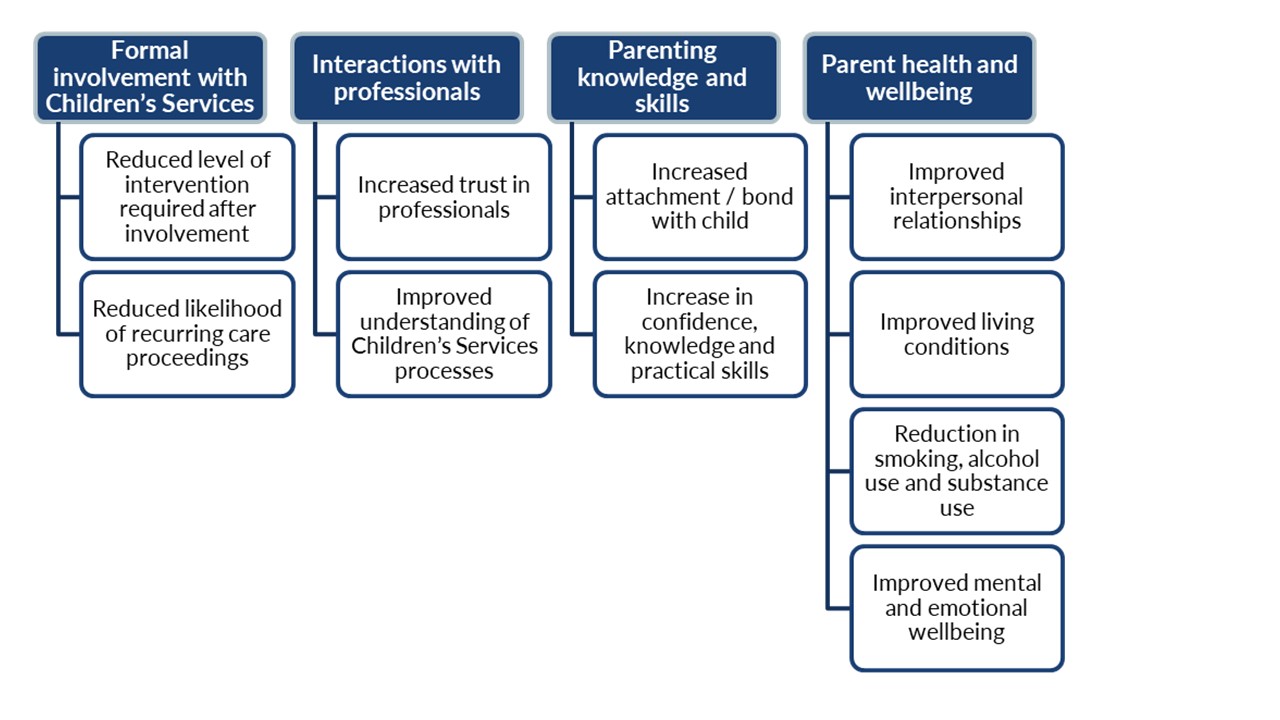
Formal involvement with Children’s Services
This group of outcomes reflect the core preventative aim of services, and their range reflects the different level of statutory service involvement required for each child, depending on need. This includes whether the child entered care, if they were placed on a child protection plan, or if the family were re-referred to social services after the end of the intervention. They have the greatest potential associated cost, although it is important to note that this varies depending on the outcome for the child (as discussed in Section 2). They are typically measured using impact measurement data.
In general, evaluations highlight the success of services in reducing risk and encouraging the child to remain in parental care, where appropriate. Typically, this was measured at the end of involvement with the service, with some measuring the proportion of cases with a positive or successful outcome for the child (Ward et al., 2019; Burch, Allen and Coombes, 2020), and others measuring those remaining on child protection plans (Turnpenny et al., 2020; Research in Practice, 2022). Rather than simply measuring the proportion of children entering care, it may also be important to highlight cases where the child is being cared for by parents successfully, despite them entering care for a short period. For example, of those involved in Calderdale’s Positive Choices scheme, 58% of children were being cared for successfully by the end of the intervention, even if they entered care for a short period (Burch, Allen and Coombes, 2020).
Some evaluations use comparisons to determine the effectiveness of the service, however this needs to be done with caution. It may be unreliable to compare in general terms: for example, the proportion of children involved with the service who were stepped down from statutory care plans in 12 months, versus those not involved in the service, due to comparative levels of risk (Burch, Allen and Coombes, 2020). Those engaged with a pre-birth service are targeted specifically because of the heightened level of risk, so this comparison may be unfair. Some evaluations compared outcomes with those who rejected involvement with the pre-birth service, however this is also unreliable due to small sample sizes.
It remains difficult to predict longer-term outcomes, though one outcome which can be measured after service involvement is re-referral to Children’s Services (Turnpenny et al., 2020). This was only measured in one evaluation, with only 26% of those involved with the Positive Choices scheme being re-referred, and one of these leading to a subsequent Child Protection Plan or Child in Need Plan (Burch, Allen and Coombes, 2020).
Interactions with professionals
While the first category of outcomes on statutory involvement reflects the core preventative aim of the service, the other categories highlight beneficial outcomes from engaging with services as a result of their core principles and delivery model.
This first set of benefits stem largely from the change in power dynamics compared to mainstream statutory services, reflecting the focus on building relationships. These do not necessarily have an associated cost but are likely to have long-term benefit to the family. In the evaluations we studied, these largely were presented as lived experience evidence, emerging through interviews with, and testimonials from, service users. Three of the services examined highlighted that involvement with services led to increased trust in professionals, with parents also benefitting from a more positive and collaborative relationship with statutory services, although this was sometimes strained (Ward et al., 2019; Burch, Allen and Coombes, 2020; Turnpenny et al., 2020). Due to service involvement, parents may also have a greater understanding of statutory Children’s Services processes, which was also considered a benefit (Ward et al., 2019).
Parenting knowledge and skills
Outcomes related to parenting knowledge and skills are typically related to the educative content provided as part of the service offer. These may relate to increased confidence, knowledge and skills, as well as an improved attachment or bond with the child. In the evaluations we reviewed, these were measured through a mix of impact measurement data and lived experience.
In two evaluations, existing standardised tools developed by academics were used to measure maternal attachment (Burch, Allen and Coombes, 2020; Turnpenny et al., 2020). One evaluation (Turnpenny et al., 2020), also used standardised tools to measure paternal attachment. In one evaluation, 75% of those studied were found to have high or very high attachment pre-birth, with this sustained or improved post-birth in 68% of cases (Burch, Allen and Coombes, 2020). Supplementing this with lived experience, parents described that their attachment and bond improved as a result of better understanding the baby’s needs and becoming attuned to this, as well as the specific attachment content provided as part of the pre-birth service (Burch, Allen and Coombes, 2020). The evaluation of the service in Manchester (Turnpenny et al., 2020), also highlighted practitioners’ professional knowledge which suggested the programme content focusing on attachment was useful for parents.
Two evaluations also looked to measure parenting confidence and skills. A standardised tool was used as part of one evaluation (Turnpenny et al., 2020), whereas another developed bespoke baseline and follow-on surveys (Ward et al., 2019). The standardised test highlighted high confidence in parents: 86% of parents involved in the Manchester scheme shown similar levels of confidence to those expected in the general population, with confidence remaining high post-birth (Turnpenny et al., 2020). However, the Swansea study, examining particular skill levels, highlighted safe sleeping and sterilisation as areas with low baseline scores (Ward et al., 2019). Levels across all skills studied, including those with higher baseline scores, shown statistically significant improvement at the end of the intervention. Lived experience evidence from three evaluations highlights increases in knowledge about breastfeeding, brain development, and understanding of child needs and effective parenting (Ward et al., 2019; Burch, Allen and Coombes, 2020; Turnpenny et al., 2020).
Parent health and wellbeing
The evaluations we studied also highlighted the impact of services on parental health and wellbeing. This may result from newly developed knowledge and skills through educative content, but also from relationships with practitioners and the therapeutic one-to-one content. This is also typically a mix of lived experience and impact measurement data.
Impact measurement data from a number of services highlight healthier choices made by parents. Mothers in Swansea involved in the Jig-So programme stopped smoking during pregnancy at a greater rate than the local average (Ward et al., 2019). Moreover, 62% of those involved in the Newport Baby and Me service reported reducing smoking during their involvement with the service (Research in Practice, 2022). Over 70% of service users in Swansea also highlighted improvements in diet since becoming pregnant (Ward et al., 2019). Parents involved in the Manchester service also reported reduced substance use, and an increased understanding of its impact on babies, in lived experience testimonials (Turnpenny et al., 2020).
Lived experience evidence also suggests a positive impact on wellbeing, in part due to the emotional support provided. The relationship developed with key practitioners was found to be empowering, with parents feeling more supported and less isolated (Ward et al., 2019; Turnpenny et al., 2020). Relationships with extended family improved for users across multiple services, with this substantiated by statistically significant impact measurement data on improved family relationships for service users in Swansea (Ward et al., 2019; Burch, Allen and Coombes, 2020; Turnpenny et al., 2020). Users across multiple services highlighted the ability to recognise domestic abuse and toxic relationship, as well as the confidence to access community groups (Burch, Allen and Coombes, 2020; Turnpenny et al., 2020). Practitioners in Manchester and Calderdale also highlighted improved home conditions as an impact of the service (Burch, Allen and Coombes, 2020; Turnpenny et al., 2020).
Across these four categories, there are a range of different outcomes which can result from providing pre-birth support. These extend not only to the core preventative aim of preventing parent-baby separation and its negative impacts, but also other benefits resulting from the design and delivery of services.
Without a formal evaluation, it is unfeasible to systematically collect and analyse data relating to all these outcomes, especially as part of ongoing service delivery. However, these do provide an indication of the outcomes which could occur as a result of Magu in RCT. In the next section, we turn our focus to Magu, to determine how well the service aligns with the core principles and models of delivery outlined in section 5.
Key Points
We identified four key groups of outcomes which result from involvement with services intending to prevent parent-baby separation. These reflect the core preventative aim of such services, as well as other benefits resulting from how they are designed and delivered. Key outcomes include:
Reduced level of children’s services intervention and reduced likelihood of recurring care proceedings.
Increased trust in professionals and improved understanding of children’s services.
Improvement in reported parenting confidence, skills and attachment with their child.
Improved parent health and wellbeing, including reduction in smoking and alcohol use and reduced social isolation.
Read the next section: What are the delivery models and core principles of the services offered in RCT?
Cliciwch yma am y Gymraeg
Understanding the key principles and models of delivery is crucial in recognising the preventative approach taken by services. Our approach to determining the potential impact of services in RCT, in lieu of a formal evaluation, involves determining the alignment of services in RCT to the models found elsewhere (section 7). To do this, we therefore need to also establish what outcomes similar services have, to see what the range of outcomes could be in RCT.
We reviewed the same four evaluations of other services aiming to prevent parent-baby separation as discussed in the section above. Reviewing evaluations can provide a robust set of different possible outcomes, but it is important to note that these outcomes may not be routinely measured by the service, and that many outcomes may be unfeasible to measure beyond the scope of a formal evaluation.
We found four main categories of outcomes, shown in Figure 1 below.
Figure 1: Identified outcomes of providing intensive pre-birth support
Formal involvement with Children’s Services
This group of outcomes reflect the core preventative aim of services, and their range reflects the different level of statutory service involvement required for each child, depending on need. This includes whether the child entered care, if they were placed on a child protection plan, or if the family were re-referred to social services after the end of the intervention. They have the greatest potential associated cost, although it is important to note that this varies depending on the outcome for the child (as discussed in Section 2). They are typically measured using impact measurement data.
In general, evaluations highlight the success of services in reducing risk and encouraging the child to remain in parental care, where appropriate. Typically, this was measured at the end of involvement with the service, with some measuring the proportion of cases with a positive or successful outcome for the child (Ward et al., 2019; Burch, Allen and Coombes, 2020), and others measuring those remaining on child protection plans (Turnpenny et al., 2020; Research in Practice, 2022). Rather than simply measuring the proportion of children entering care, it may also be important to highlight cases where the child is being cared for by parents successfully, despite them entering care for a short period. For example, of those involved in Calderdale’s Positive Choices scheme, 58% of children were being cared for successfully by the end of the intervention, even if they entered care for a short period (Burch, Allen and Coombes, 2020).
Some evaluations use comparisons to determine the effectiveness of the service, however this needs to be done with caution. It may be unreliable to compare in general terms: for example, the proportion of children involved with the service who were stepped down from statutory care plans in 12 months, versus those not involved in the service, due to comparative levels of risk (Burch, Allen and Coombes, 2020). Those engaged with a pre-birth service are targeted specifically because of the heightened level of risk, so this comparison may be unfair. Some evaluations compared outcomes with those who rejected involvement with the pre-birth service, however this is also unreliable due to small sample sizes.
It remains difficult to predict longer-term outcomes, though one outcome which can be measured after service involvement is re-referral to Children’s Services (Turnpenny et al., 2020). This was only measured in one evaluation, with only 26% of those involved with the Positive Choices scheme being re-referred, and one of these leading to a subsequent Child Protection Plan or Child in Need Plan (Burch, Allen and Coombes, 2020).
Interactions with professionals
While the first category of outcomes on statutory involvement reflects the core preventative aim of the service, the other categories highlight beneficial outcomes from engaging with services as a result of their core principles and delivery model.
This first set of benefits stem largely from the change in power dynamics compared to mainstream statutory services, reflecting the focus on building relationships. These do not necessarily have an associated cost but are likely to have long-term benefit to the family. In the evaluations we studied, these largely were presented as lived experience evidence, emerging through interviews with, and testimonials from, service users. Three of the services examined highlighted that involvement with services led to increased trust in professionals, with parents also benefitting from a more positive and collaborative relationship with statutory services, although this was sometimes strained (Ward et al., 2019; Burch, Allen and Coombes, 2020; Turnpenny et al., 2020). Due to service involvement, parents may also have a greater understanding of statutory Children’s Services processes, which was also considered a benefit (Ward et al., 2019).
Parenting knowledge and skills
Outcomes related to parenting knowledge and skills are typically related to the educative content provided as part of the service offer. These may relate to increased confidence, knowledge and skills, as well as an improved attachment or bond with the child. In the evaluations we reviewed, these were measured through a mix of impact measurement data and lived experience.
In two evaluations, existing standardised tools developed by academics were used to measure maternal attachment (Burch, Allen and Coombes, 2020; Turnpenny et al., 2020). One evaluation (Turnpenny et al., 2020), also used standardised tools to measure paternal attachment. In one evaluation, 75% of those studied were found to have high or very high attachment pre-birth, with this sustained or improved post-birth in 68% of cases (Burch, Allen and Coombes, 2020). Supplementing this with lived experience, parents described that their attachment and bond improved as a result of better understanding the baby’s needs and becoming attuned to this, as well as the specific attachment content provided as part of the pre-birth service (Burch, Allen and Coombes, 2020). The evaluation of the service in Manchester (Turnpenny et al., 2020), also highlighted practitioners’ professional knowledge which suggested the programme content focusing on attachment was useful for parents.
Two evaluations also looked to measure parenting confidence and skills. A standardised tool was used as part of one evaluation (Turnpenny et al., 2020), whereas another developed bespoke baseline and follow-on surveys (Ward et al., 2019). The standardised test highlighted high confidence in parents: 86% of parents involved in the Manchester scheme shown similar levels of confidence to those expected in the general population, with confidence remaining high post-birth (Turnpenny et al., 2020). However, the Swansea study, examining particular skill levels, highlighted safe sleeping and sterilisation as areas with low baseline scores (Ward et al., 2019). Levels across all skills studied, including those with higher baseline scores, shown statistically significant improvement at the end of the intervention. Lived experience evidence from three evaluations highlights increases in knowledge about breastfeeding, brain development, and understanding of child needs and effective parenting (Ward et al., 2019; Burch, Allen and Coombes, 2020; Turnpenny et al., 2020).
Parent health and wellbeing
The evaluations we studied also highlighted the impact of services on parental health and wellbeing. This may result from newly developed knowledge and skills through educative content, but also from relationships with practitioners and the therapeutic one-to-one content. This is also typically a mix of lived experience and impact measurement data.
Impact measurement data from a number of services highlight healthier choices made by parents. Mothers in Swansea involved in the Jig-So programme stopped smoking during pregnancy at a greater rate than the local average (Ward et al., 2019). Moreover, 62% of those involved in the Newport Baby and Me service reported reducing smoking during their involvement with the service (Research in Practice, 2022). Over 70% of service users in Swansea also highlighted improvements in diet since becoming pregnant (Ward et al., 2019). Parents involved in the Manchester service also reported reduced substance use, and an increased understanding of its impact on babies, in lived experience testimonials (Turnpenny et al., 2020).
Lived experience evidence also suggests a positive impact on wellbeing, in part due to the emotional support provided. The relationship developed with key practitioners was found to be empowering, with parents feeling more supported and less isolated (Ward et al., 2019; Turnpenny et al., 2020). Relationships with extended family improved for users across multiple services, with this substantiated by statistically significant impact measurement data on improved family relationships for service users in Swansea (Ward et al., 2019; Burch, Allen and Coombes, 2020; Turnpenny et al., 2020). Users across multiple services highlighted the ability to recognise domestic abuse and toxic relationship, as well as the confidence to access community groups (Burch, Allen and Coombes, 2020; Turnpenny et al., 2020). Practitioners in Manchester and Calderdale also highlighted improved home conditions as an impact of the service (Burch, Allen and Coombes, 2020; Turnpenny et al., 2020).
Across these four categories, there are a range of different outcomes which can result from providing pre-birth support. These extend not only to the core preventative aim of preventing parent-baby separation and its negative impacts, but also other benefits resulting from the design and delivery of services.
Without a formal evaluation, it is unfeasible to systematically collect and analyse data relating to all these outcomes, especially as part of ongoing service delivery. However, these do provide an indication of the outcomes which could occur as a result of Magu in RCT. In the next section, we turn our focus to Magu, to determine how well the service aligns with the core principles and models of delivery outlined in section 5.
Key Points
We identified four key groups of outcomes which result from involvement with services intending to prevent parent-baby separation. These reflect the core preventative aim of such services, as well as other benefits resulting from how they are designed and delivered. Key outcomes include:
Reduced level of children’s services intervention and reduced likelihood of recurring care proceedings.
Increased trust in professionals and improved understanding of children’s services.
Improvement in reported parenting confidence, skills and attachment with their child.
Improved parent health and wellbeing, including reduction in smoking and alcohol use and reduced social isolation.
Read the next section: What are the delivery models and core principles of the services offered in RCT?